Good work! I think your idea to switch to machine hours is smart
This challenge was a good refresher on how to run regressions in Excel! I found that machine hours was the best predictor of manufacturing overhead costs with an R-square value of 0.9136.

1 Like
Thanks for the challenge!
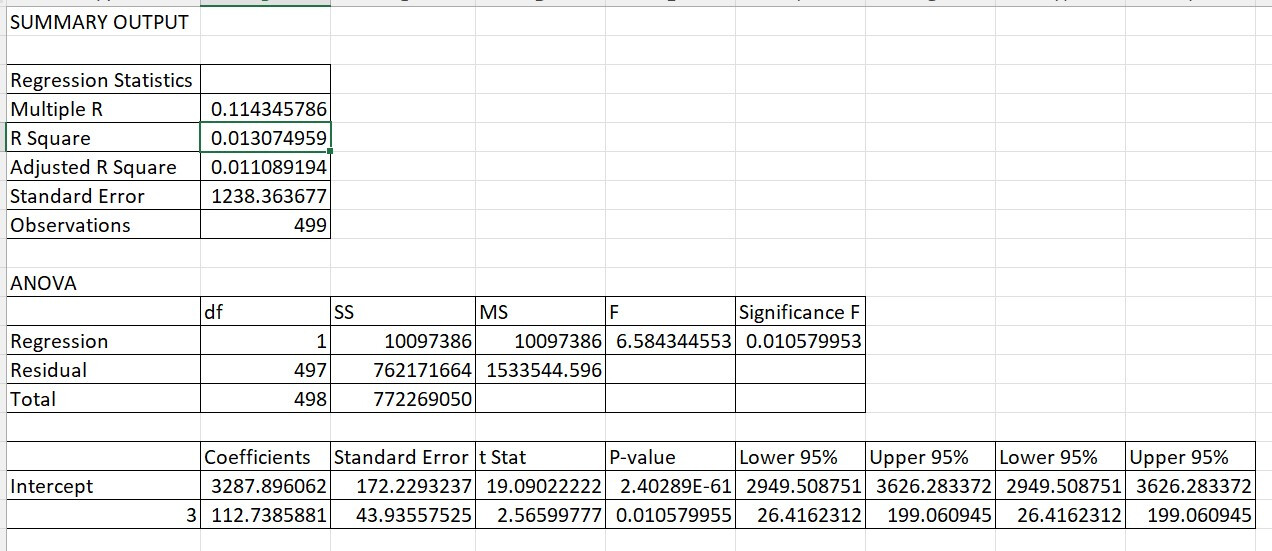
R Square with running Direct Labor Hours as the x-variable: 0.01127532
Here is the link to my solutions:
Challenge61_Data (1).xlsx (42.6 KB)
1 Like

The machine hours is the best option for drivers to determine overhead. It had an r-squared of .913 which almost a direct relationship.
The greatest correlation was with machine hours which therefore made it the best predictor. It had an r-squared of .913.
ACC 407-Techhub-Challenge61_Data.xlsx (66.7 KB)
1 Like
I used machine hours and it proved to be a better indicator with R squared being 0.91
RegressionChallenege.xlsx (41.5 KB)



Nice Maddy. Good work.

great project! I got an r^2 of 0.913564068302052
I used the labor hours as the denominator for finding the MOH rate, and the coefficient was similar to the regression output for using headcount in the rate. Neither labor hours nor headcount is a good cost driver for allocating MOH.


MasonLewis_Challenge61_Excel.xlsx (76.8 KB)
According to the regression analysis for this challenge, Machine Hours is the best cost driver to use to estimate MOH with a R square value of 0.91. Thanks for the great challenge!


R squared is 0.913564068 therefore Machine Hours and MOH would be the best Cost Drivers according to our regression analysis.

I ran a regression based off machine hours and overhead. This got me to a R square of .913
Challenge61_Data.xlsx (54.1 KB)
Challenge61_Data.xlsx (60.4 KB)
I used machine hours for my estimate and as my best combo for predicting manufacturing overhead.


Challenge61_Data.xlsx (63.3 KB)